



What is the ideal business model?
While views may differ, assessments often focus on three criteria: profitability, scalability, and defensibility. A business that performs strongly on these dimensions generates substantial profits relative to the capital it requires, grows with limited incremental effort or additional capital, and can sustain its success over long periods. These are certainly not the only possible criteria for judging a business, but they help explain why certain business models are regarded as especially attractive from the perspective of investors and managers.
Our claim is that platform businesses come closer to this Platonic ideal than any other type of business. It is possible to find individual businesses that outperform platforms on any one of these dimensions. But it is difficult to find a business model that combines all three as effectively as a successful platform.
To make that case, we first explain why platforms are such powerful businesses. We then compare them with other leading contenders—including software-as-a-service (SaaS), licensing, scale-economies, and learning-by-doing businesses—and conclude with several important caveats and nuances.
Why platforms are great businesses
The word “platform” has many meanings. Throughout this article, we use a precise definition: platform businesses enable direct interactions between customers who have chosen to join the platform.
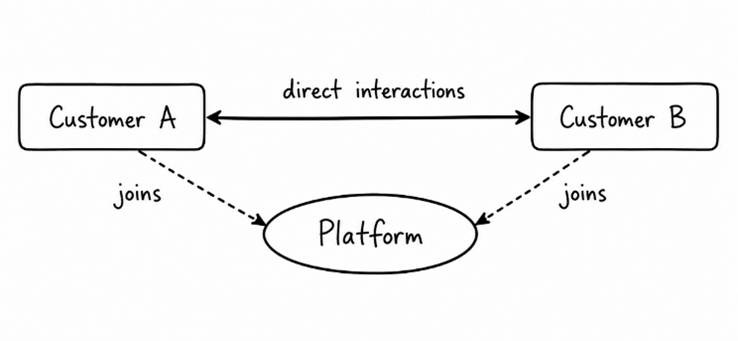
This includes marketplaces such as Alibaba, Airbnb, Booking.com, eBay, Mercado Libre, Pinduoduo, and Upwork; social networks such as Instagram, Reddit, TikTok, and X; messaging apps such as Discord, Telegram, and WhatsApp; operating systems such as Android and Windows; and payment systems such as Alipay, Mastercard, PayPal, Venmo, and Visa.
Importantly, this definition excludes businesses that buy and resell products in their own name, such as Foot Locker, Apple Music, and GameStop. It also excludes simply supplying B2B software tools to one side of a market—such as Stripe’s payment APIs, Twilio’s communications APIs, or HubSpot’s CRM software—even when customers can program, customize, or build upon them. Enabling customers to build on a product is not the same as enabling direct interactions among participants who have joined the service.
Internal “platforms,” whether software components or shared physical-product designs, help a company develop its own offerings rather than connect customers, so they are not platform businesses in our sense. Open standards can be viewed as platforms in a broader sense and become more valuable with wider adoption, but a standard is not itself a business.
Businesses can, however, acquire platform elements over time. AWS began as a B2B provider of cloud services accessible through APIs, then added platform elements by enabling third-party developers to offer complementary solutions to its customers, notably through AWS Marketplace. This illustrates a continuum rather than an all-or-nothing distinction: businesses can combine products and platform elements, whose importance depends on how much value participants create for one another. For a more comprehensive discussion, see our post “What are platform businesses?”.
Given this definition, platforms possess enormous leverage by their very nature.
The first reason is network effects. As more users join, the platform becomes more valuable because there are more users to transact or interact with. A social network becomes more useful as more people participate. A marketplace becomes more attractive to buyers as more sellers join—and vice versa. An operating system becomes more valuable to users as more applications are developed for it, and more attractive to developers as its installed base grows.
The second reason is that platforms have inherently asset-light cost structures. Because value is created primarily through interactions among users, platforms generally hold little or no inventory, own few physical assets, and require limited capital expenditure. Booking.com does not own or manage hotels, eBay does not operate warehouses or logistics networks, and Instagram does not pay for the content that attracts users and advertisers to the platform.
Margins are useful for understanding cost structures but can be misleading across business models: a marketplace generally records only its fees as revenue, whereas a reseller records the full value of the goods sold and the supplier payout as a cost. For cross-model comparisons, return on invested capital (ROIC), which measures the profit generated relative to the capital the business itself must commit, is a more meaningful measure.
Together, the two characteristics described above—network effects and asset-light cost structures—can allow successful platforms to generate exceptional returns on invested capital. Because participants provide much of the inventory, content, assets, and operating capacity, platforms can earn substantial profits without financing many of the resources that traditional businesses must own or fund themselves. A retailer must finance inventory and distribution; a hotel operator must finance or support physical capacity; a media company must pay to produce or acquire much of its content. Marketplaces, social networks, and other platforms can shift much of this investment to participants.
The difference can be striking. In 2025, Airbnb and Booking Holdings, the parent of Booking.com, generated substantial after-tax operating profits while requiring so little net capital that their calculated invested capital was actually negative, making a conventional ROIC percentage meaningless. Hilton and Marriott, by contrast, generated ROIC of roughly 25–30%, even though each owns or leases only about one in every 200 properties in their systems. The comparison shows that platforms can push capital-light economics even further than businesses already considered exceptionally asset-light.
Platforms are also exceptionally scalable. Traditional businesses typically grow by expanding their own resources: more customers require more stores, factories, inventory, employees, or other organizational capacity. Platforms are different because much of the additional capacity comes from participants themselves. Hosts expand Airbnb’s supply of accommodations, creators expand YouTube’s library of content, and merchants expand Visa’s acceptance network. In 2025, OnlyFans facilitated roughly $8 billion of transactions while employing fewer than 50 people and retaining more than $500 million in profit.
Finally, platforms are exceptionally defensible. Once a large network of users has formed, new challengers face a difficult chicken-and-egg problem. A rival social network must persuade users to leave behind their friends, followers and communities. A rival marketplace must simultaneously attract both buyers and sellers despite having fewer of each. A rival operating system must convince users to switch despite having fewer applications, while also convincing developers to build applications despite having fewer users. These barriers tend to strengthen as the platform grows, making successful platforms among the most durable businesses in the economy. Just consider what it would take to unseat Airbnb, Visa, Windows or YouTube.
Platforms vs. other contenders
The discussion so far explains why platforms are attractive businesses in isolation. But the relevant question is whether they are better than other types of businesses with highly attractive economic characteristics that have also generated extraordinary shareholder value. To answer that question, it is useful to compare platforms against the strongest contenders—software-as-a-service (SaaS) businesses, scale-economies businesses, licensing businesses, and learning-by-doing businesses—along the same three dimensions: profitability, scalability, and defensibility.
Platforms vs. SaaS businesses
Non-platform SaaS businesses are a natural benchmark because they share many of the same attractive economic characteristics associated with businesses built on software: high gross margins (well above 75%), low marginal costs, and strong customer lock-in. Their key source of defensibility is high switching costs: once embedded in an organization’s workflows, SaaS products can be difficult and costly to replace.
The fundamental difference is that SaaS products do not become inherently more valuable simply because more customers adopt them. SaaS companies like SAP, Snowflake and Workday must continuously invest in product development, sales, and marketing to create additional value and attract additional customers. By contrast, successful platforms can often sit back and watch value compound: users create additional value for one another as the network grows.
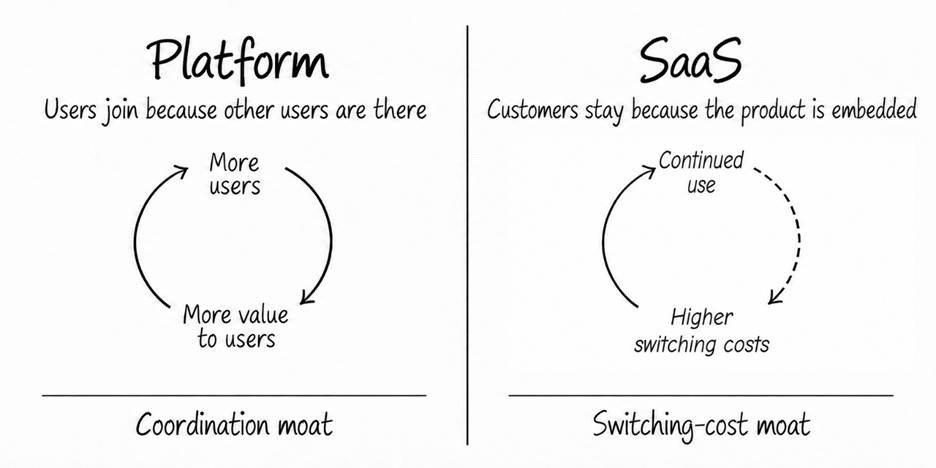
SaaS can have a reinforcing loop when continued use builds product-specific data, workflows or skills that make switching increasingly costly; the dashed arrow in the right-hand panel of the figure above marks this condition. Unlike network effects, however, this reinforcement operates within an existing customer relationship and does not, by itself, make the product more valuable to other customers. Thus, switching costs primarily help retain existing customers, whereas network effects also attract new ones. Nobody chooses a system because they want to get locked in; they may choose a platform precisely because other participants make it valuable.
The ultimate compliment paid to the platform business model by successful SaaS companies is that many of them have added platform elements to their products, in an effort to boost growth and enhance defensibility. Rather than remaining pure software vendors, SaaS companies like Salesforce, HubSpot, Intuit, Shopify and ServiceNow have all opened APIs, encouraged third-party development, and launched app marketplaces around their core offerings.
Platforms vs. scale-economies businesses
Like platforms, scale-economies businesses become stronger as they grow, yet they do so for fundamentally different reasons. Retailers such as Walmart, Costco, and Target, media companies such as Netflix and Disney, and industrial giants such as Saudi Aramco all benefit from spreading large fixed costs over enormous volumes of activity. As they grow, they can also negotiate better terms with suppliers, invest in infrastructure more efficiently, and operate at lower unit costs than smaller rivals.
The key difference is that the benefits of scale have a natural limit (average costs can only be reduced up to a point), whereas the value created by network effects can compound much more rapidly and much further, as new participants make the platform increasingly useful to one another. Walmart’s scale allows it to negotiate better prices with suppliers and operate a more efficient logistics network, but an additional Walmart shopper does not make the shopping experience more valuable for existing shoppers. The difference is better reflected in capital requirements than in accounting margins. Walmart must finance inventory, stores, distribution centers, and working capital to expand, whereas sellers on a marketplace like eBay provide the inventory and fulfillment capacity themselves. A retailer can generate excellent returns despite low margins by turning inventory rapidly, but a successful marketplace can generate high returns while committing very little capital in the first place.
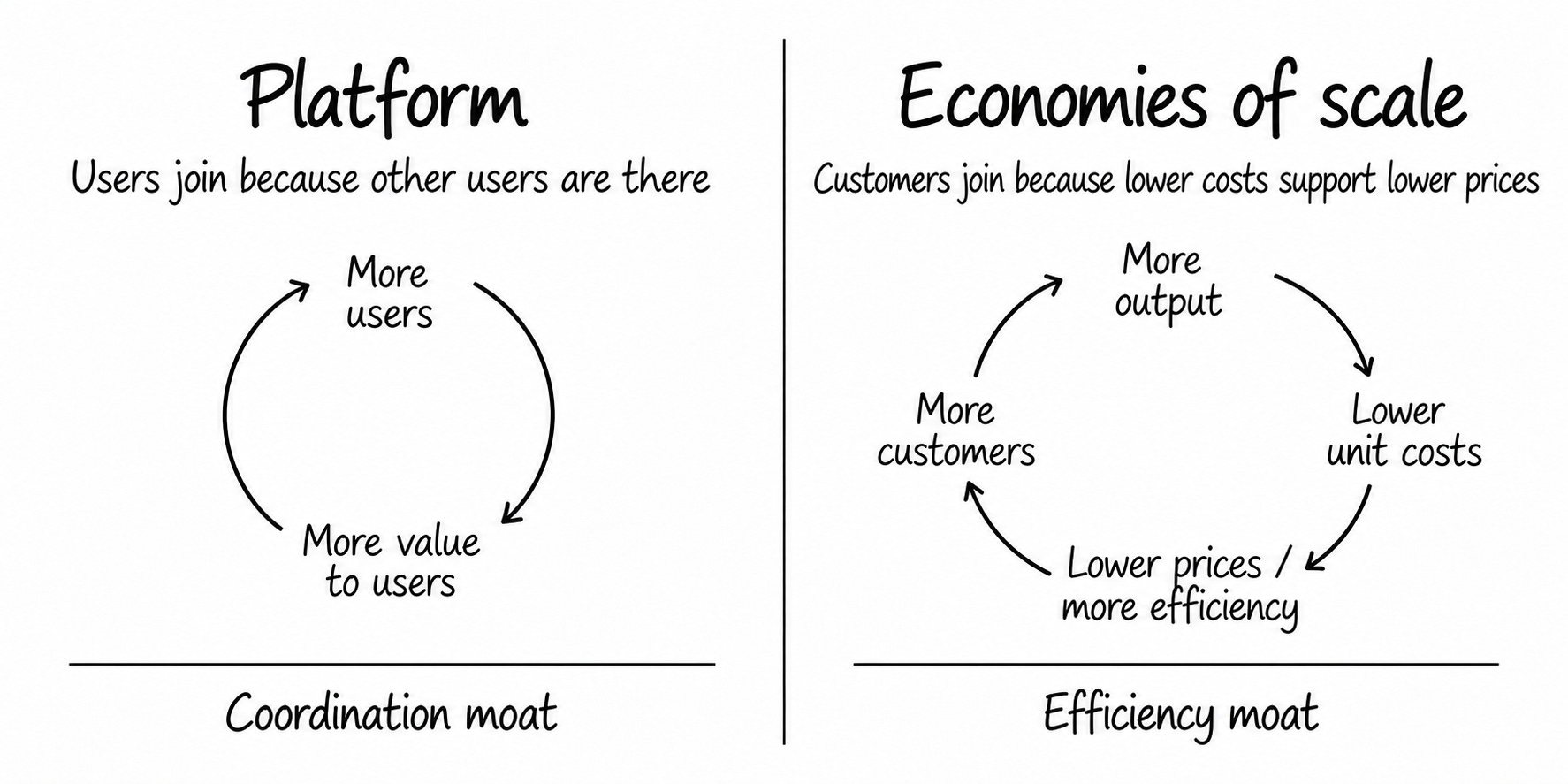
At the same time, scale-economies businesses retain important advantages of their own. The same integration that limits scalability can improve execution by giving firms tighter control over product quality, customer experience, and the coordination of activities across the value chain.
The boundary between the two models has become increasingly blurred. Recognizing the attractiveness of platform economics, retailers such as Walmart and Target have launched online marketplaces that allow third-party sellers to transact directly with customers, while Amazon.com has evolved from a retailer into a hybrid retailer-marketplace. Conversely, some platforms have moved in the opposite direction. Shopee and Mercado Libre increasingly provide logistics, payments, fulfillment, and other services that resemble those of traditional retailers. The direction of travel in both cases is telling: retailers seek the scalability and defensibility of platforms, while platforms selectively internalize activities when doing so improves the customer experience.
Platforms vs. licensing businesses
Whether licensing a brand, business format, or intellectual property, companies such as McDonald’s, Hilton, Qualcomm, and ARM can grow with relatively little capital investment. Like platforms, they often enjoy high margins, strong returns on capital, and exceptional scalability because the underlying asset can be reused many times at little incremental cost.
The key difference is the nature of the asset being licensed. Franchisors license a brand and operating system; IP owners license technology and intellectual property; platforms effectively license access to a network of participants. All three models can generate exceptionally high returns on capital because serving additional franchisees, licensees, or platform participants requires relatively little incremental investment.
The strongest case for platforms emerges on growth and defensibility. Adding another hotel to Booking requires relatively little investment by the platform, whereas expanding a franchise network requires recruiting, vetting, supporting, and monitoring additional franchisees. A franchisor must also help each new property meet brand standards, integrate its operating systems, train staff, and provide ongoing operational support, while Booking can add a hotel largely by onboarding its listing, availability, and payment information onto an existing digital infrastructure. Furthermore, a valuable brand or technology can help licensees win customers, but often licensing alone does not connect them directly to an existing pool of buyers, so they must still find ways to reach those customers on their own. A successful marketplace provides that connection, with buyers attracting sellers and sellers attracting buyers. This reciprocal attraction can make growth more self-reinforcing for platforms.
For defensibility, franchisors rely primarily on brand strength and operational know-how, while IP licensors depend on patents, standards, and technological leadership. Both are reinforced by economies of scale: investments in brand-building or IP can be spread across many licensees and the sales they generate. Some franchise systems also benefit from purchasing at scale—for example, McDonald’s coordinates sourcing from independent suppliers across its restaurants to secure favorable terms for food and other inputs. These can be powerful moats, but they require continual reinvestment. Companies such as ARM and Qualcomm must spend heavily on research and development to keep their intellectual property portfolios fresh and remain ahead of competing standards and architectures. If innovation slows, their licensing position can gradually erode as customers adopt alternative technologies. Platforms can also benefit from economies of scale, but network effects are their key source of advantage. Unlike a patent portfolio or a franchise manual, the network itself can become more valuable and harder to displace as it grows, with participants creating much of the additional value. As a result, platforms enjoy a more durable advantage.
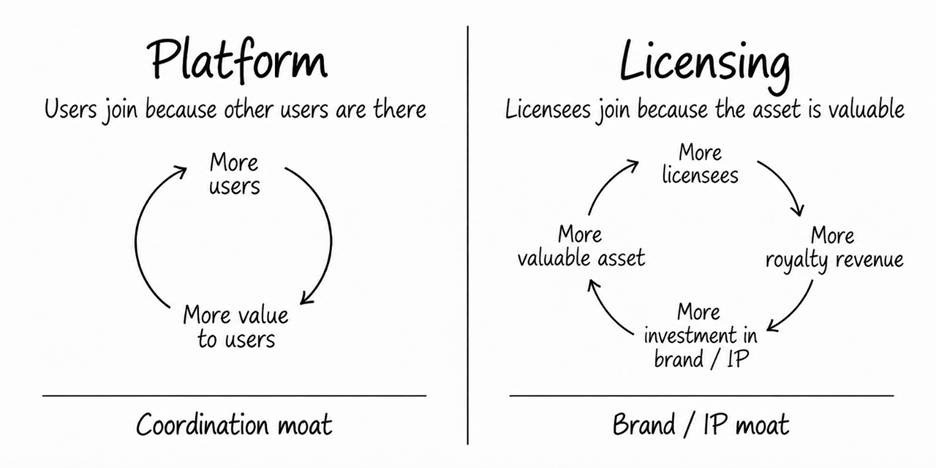
As with retailers and platforms, the boundary between franchisors and platforms is becoming increasingly blurred. Many franchisors have introduced platform elements that connect customers across franchise locations. Hilton’s centralized booking and loyalty programs make each participating hotel more valuable to travelers, while McDonald’s mobile ordering and loyalty platform spans thousands of franchisees. These initiatives supplement successful franchising businesses with the network effects that make platforms so powerful.
Platforms vs. learning by doing businesses
Learning-by-doing businesses are perhaps the strongest non-platform contender for the title of greatest business model because, like platforms, they benefit from self-reinforcing feedback loops. In both cases, serving more customers creates additional value, which attracts more customers, which in turn creates still more value. Quintessential examples include industrial businesses such as TSMC and ASML, who have built near-monopoly positions through decades of accumulated manufacturing experience, as well as digital businesses such as Tesla’s self-driving system, NVIDIA’s chip designs, and large language models such as ChatGPT and Claude. These businesses learn and improve through continued production and customer usage, allowing market leaders to pull further ahead of less active rivals.
The key difference is that network effects involve a coordination game among users, whereas learning-by-doing does not. A user may prefer Airbnb because other hosts and guests are already there, Visa because more merchants accept it, or Windows because more developers build applications for it. By contrast, customers choose TSMC, Tesla, ChatGPT or Claude primarily because they believe the product is better. The advantage comes from superior quality rather than from coordinating with other users. This distinction matters because learning-by-doing businesses must continually remain ahead of competitors on the learning curve. Their products are judged primarily on their intrinsic merits, making them vulnerable to technological breakthroughs. One could argue that they are always one competitor’s innovation away from losing their advantage.
By contrast, a platform can remain dominant even after competitors develop superior features or technologies, simply because users care about where other users are. In that sense, network effects can create a more durable form of competitive advantage than learning-by-doing.
Yet the opposite argument can be made. Learning-by-doing creates advantage based on product quality rather than user coordination. A social network may be one generational shift away from irrelevance, whereas TSMC’s manufacturing expertise has accumulated over decades and cannot be replicated quickly. In some settings, learning-by-doing may therefore prove more durable than network effects.
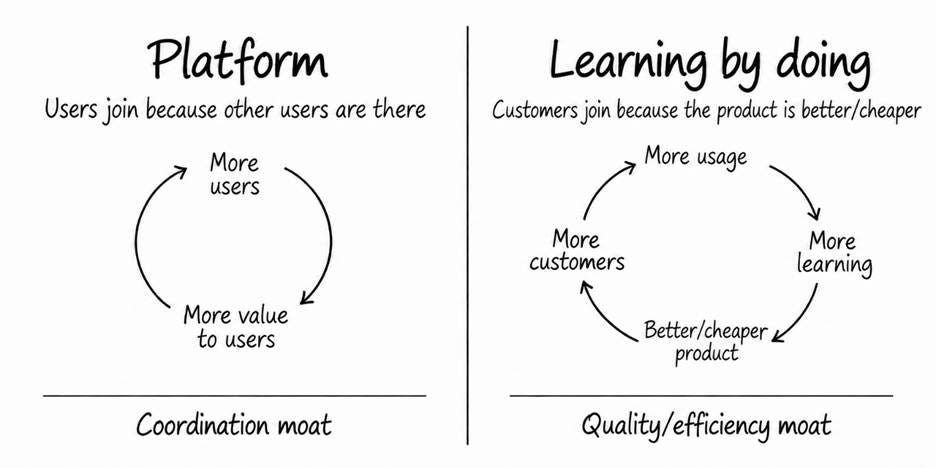
On balance, platforms retain an advantage because once critical mass is reached, network effects are generally faster and cheaper to build than learning-by-doing. A social network can see adoption explode, even without substantial investment by the platform itself. By contrast, learning advantages like those achieved by TSMC and ASML require decades of investment, experimentation, and accumulated experience, as well as continual spending on increasingly expensive manufacturing and R&D capabilities. Digital learning systems such as modern AI models can scale more easily, but they too require substantial investments in computing infrastructure and engineering talent.
Moreover, learning advantages can often be imitated unless the leader continues climbing the learning curve faster than competitors: cutting-edge machine learning and neural network algorithms tend to be adopted quickly by all major competitors. Even recursive self-improvement (RSI), an extreme form of learning-by-doing in which AI models help develop still better models, would not by itself prevent rival labs from following the same path. The leader’s advances could even help rivals catch up through talent movement and distillation, whereby rivals train their models using outputs from the leader’s models. Network effects, by contrast, become harder to replicate as the network grows because rivals can be deprived of the critical mass of users needed to compete.
Caveats and nuances
The preceding discussion has intentionally emphasized the unique advantages of platforms in terms of profitability, scalability, and defensibility. Yet several important qualifications are in order. Not all platforms achieve extraordinary profitability, platforms are often difficult and expensive to build, and many of the world’s most valuable platform companies derive much of their success from combining network effects with other sources of competitive advantage.
Not all platforms are exceptionally profitable
Exceptional returns on capital do not necessarily imply exceptional margins, and platform businesses vary widely on both measures. Even among mature platforms, operating margins can differ dramatically. Ride-sharing and delivery platforms such as Uber and DoorDash generated negative operating margins for most of their histories, with Uber first achieving a positive operating margin in 2023 and DoorDash doing so in 2024, despite their scale and strong network effects. And some mature marketplaces generate lower margins than the examples we have seen so far. Over the past three years, Etsy and Upwork generated average operating margins of roughly 11% and 8%, respectively, compared with about 20% for Airbnb and 31% for Booking.
One reason is that the most profitable platforms are often those that do the least. Consider specialized listing platforms such as Auto Trader and Rightmove. Auto Trader operates a marketplace where car dealers and private sellers pay to advertise vehicles to prospective buyers, while Rightmove allows estate agents and property developers to list homes for sale or rent and attract potential buyers and tenants. Their role is primarily to aggregate listings and direct interested customers to sellers. They do not facilitate payments, provide logistics, finance transactions, or offer extensive customer support. As a result, both Auto Trader and Rightmove have operating margins of close to 70%. Payment platforms such as Visa and Mastercard are similarly specialized. They facilitate payments, but do not help users discover trading partners as marketplaces do, nor do they get involved in financing. Their role is limited to moving information and money between participants, which helps explain their operating margins of around 60%.
Most platforms, however, cannot remain so detached from the transactions they facilitate. To create trust and reduce friction, they often provide services such as fraud prevention, trust and safety systems, dispute resolution, insurance programs, payment processing, and customer support. These services create value for participants and help strengthen the platform, but they also add significant costs which drag down profit margins. The more transactions touch the physical world, the greater the need for such services. Airbnb must manage trust and safety for millions of hosts and guests; Etsy must police fraud and counterfeit products; Uber and DoorDash must coordinate drivers, customers, restaurants, and merchants in real time.
A second reason for the disparity in operating margins is that platforms can earn extraordinary margins only when their network effects are strong enough to reduce the need for customer acquisition and competitive spending. Several factors limit the ability of network effects to translate into high margins: low purchase frequency and weak habitual engagement (Etsy), the potential for disintermediation (Upwork), local rather than global interactions (Uber, DoorDash), and low costs of participating on multiple competing platforms (Uber, DoorDash). When network effects are weaker, platforms must spend more aggressively on marketing, incentives, and subsidies to attract and retain participants. Etsy and Upwork devote substantial resources to customer acquisition, while Uber and DoorDash spend heavily on driver and courier incentives.
Platforms are hard to build
Platforms create the potential for extraordinary profitability, scalability, and defensibility, but only successful platforms that become dominant in their markets fully realize that potential. Once we account for the probability of failure and the costs of overcoming the cold start problem inherent in platforms, it becomes less obvious that platforms are always the best businesses to pursue—at least for startup founders.
The reason is that the network effects that make platforms defensible also make them hard to build. Buyers will not join a marketplace without sellers, sellers will not join without buyers, drivers will not join without riders, and vice versa. Unlike a traditional product company, a platform cannot simply create value on its own and then sell it to customers.
Many platforms never overcome the cold start problem because attracting participants often requires substantial spending on customer acquisition, subsidies and incentives. The challenge is so significant that many successful platforms did not begin life as platforms at all. Instead, they first created value for one side of the market and only later evolved into platforms. Amazon began as an online retailer before opening its marketplace to third-party sellers. OpenTable initially sold reservation-management software to restaurants before leveraging that installed base to attract diners. Google first built a large user base through the quality of its search engine before introducing advertisers and other platform businesses.
This suggests that the platform model is often better viewed as a destination than as a starting point. For many startup entrepreneurs, it might be easier to begin with a product, service, or retailer model that creates standalone value, and then gradually transform it into a platform.
The most valuable platform companies are usually hybrids
While pure platforms represent the clearest expression of network effects and can generate exceptional returns on capital, the most valuable platform companies in the world are rarely pure platforms. Some began as product companies and later added platform elements. Apple transformed the iPhone into a platform through APIs and the App Store. NVIDIA supplemented its industry-leading chips with the CUDA software platform that allows developers to build applications on top of its hardware. Amazon.com started as a retailer and then opened up its marketplace to third-party sellers; it then launched Amazon Web Services first as a product, before opening up its APIs and an AWS marketplace for third-party developers. Others followed the opposite path. Microsoft expanded from Windows into cloud services, and marketplaces such as Alibaba, Mercado Libre, Pinduoduo, and Shopee increasingly offer logistics, payments, fulfillment, lending, and other services. All of these businesses combine network effects with other sources of competitive advantage: economies of scale, learning-by-doing, or brand advantages.
Yet the platform component is usually the critical lynchpin that drives growth and defensibility. Had it not opened the iPhone’s APIs and launched the App Store, Apple would likely have become one of several smartphone manufacturers competing primarily on hardware and brand on Android or some other operating system. Without Windows, Microsoft Azure would have struggled to become one of the world’s leading cloud platforms. Without its marketplace, Amazon.com would be a large online retailer but not nearly as dominant in ecommerce. NVIDIA’s hardware leadership depends in large part on the network effects and switching costs created by the CUDA software platform. And Google’s dominant position in search owes much to its powerful platform assets—including its advertising platforms, Android and YouTube.
At the same time, pure platforms rarely reach the very highest valuations. Many mature marketplaces eventually encounter growth limits once they have saturated their core markets. For example, close to six years after its 2020 IPO, Airbnb’s market capitalization is almost unchanged. Similarly, eBay and Etsy have experienced long periods of relatively modest growth. By definition, a pure marketplace is primarily a facilitator of transactions; its opportunities to launch entirely new products or services are limited. Hybrid businesses enjoy greater flexibility. Amazon leveraged capabilities developed in support of its marketplace and retail operations to launch Amazon Web Services, Fulfillment by Amazon, advertising, and other business lines. This explains why Amazon’s valuation increased from $26 billion at the end of 1999 to $2.8 trillion in October 2026. By contrast, during the same period, eBay’s valuation has fluctuated roughly between $9 and $80 billion.
Other large marketplaces are following Amazon’s model: sacrificing some of the purity of the platform model in order to increase the total value of the business. Mercado Libre leveraged its marketplace to build payments, logistics, and lending businesses. Shopee increasingly combines marketplace operations with first-party retail in selected categories, where reliability and inventory availability are particularly important. Pinduoduo, historically a relatively pure marketplace, has invested heavily in logistics and supply-chain capabilities, to improve speed and reliability, which increases repeat purchases.
None of this negates the exceptional power of the platform business model. It simply suggests that in some markets it may be most effective when combined with other sources of competitive advantage.
Concluding thoughts
The key message is that, while not every platform is a great business, there is something uniquely powerful about the platform business model. Platforms are the only businesses which can be said to get better as you sleep (well, aside from Eight Sleep, which makes a smart bed that literally improves the more you sleep on it). As a result, they combine profitability, scalability, and defensibility in higher proportions than any other type of business. Network effects allow value to compound as more users join, asset-light structures support exceptional returns on capital, often accompanied by high operating margins, and coordination among participants creates durable competitive advantages that are difficult to replicate.
Rather than pursuing platforms in their purest form, managers, entrepreneurs and investors should look for platform potential. Adding platform elements to an existing business is often the most effective way to accelerate growth, increase profitability, and escape commoditization. Software companies can open APIs and create app stores. Retailers can launch marketplaces. Franchisors can connect customers across locations through common loyalty or booking platforms.
These principles are particularly relevant to today’s leading AI companies. As OpenAI and Anthropic prepare for potential public offerings, serious questions remain about both profitability and defensibility. Among others, they face growing competition from strong open-source alternatives. As model capabilities continue to improve and open-source models become good enough for many use cases, AI models risk becoming increasingly commoditized.
In that environment, the most attractive economics may not reside in the models themselves, but in the platforms built around them. OpenAI and Anthropic have both launched initiatives that point in this direction, such as OpenAI’s GPT Store and Apps in ChatGPT. Whether these particular initiatives succeed remains uncertain. What seems much more certain is that entirely new platforms will emerge around AI agents, tools, and applications. The next generation of dominant businesses may not be the companies that build the best AI models, but the companies that create the marketplaces and operating systems through which those models interact with users, AI developers and AI applications. Platforms have been the greatest businesses of the internet era and there is a good chance they will also be among the greatest businesses of the AI era.
References
This post draws on our Substack post, “What are platform businesses?”, our Harvard Business Review articles, “When Data Creates Competitive Advantage”, “Will That Marketplace Succeed?”, and “Could the GPT Store Turn ChatGPT into a Platform Powerhouse?”, as well and on our academic papers, “Multi-sided platforms” in the International Journal of Industrial Organization and “Data-enabled learning, network effects, and competitive advantage” in The RAND Journal of Economics.
***